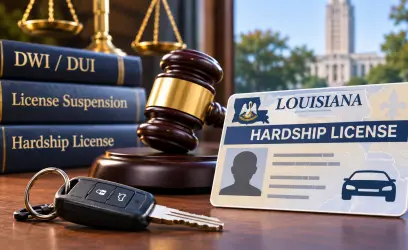
After a DWI arrest, the question that keeps most people up at night is not the court date. It is how to get to work on Monday. In Shreveport and Bossier City, where public transit is limited and many jobs require a commute, losing your license can threaten your paycheck almost immediately.
Louisiana offers two main routes back behind the wheel: a Louisiana hardship license, which lets you drive with restrictions while a suspension is in effect, and full reinstatement, which restores your regular driving privileges once the suspension ends and every requirement is met. They have different costs, conditions, and timing. This guide explains how each works, how to decide between them, and what to bring when you go to the Office of Motor Vehicles (OMV).
How Does a DWI Lead to a License Suspension in Louisiana?
Short answer: A DWI arrest usually triggers an administrative suspension through the OMV, separate from the criminal case. A conviction can bring additional suspension time. Both must be resolved before you can fully reinstate.
When you are arrested and either fail or refuse a chemical test, the officer typically takes your physical license and gives you paperwork that works as a temporary permit. Unless you request an administrative hearing within the short deadline, commonly 30 days from arrest, the suspension takes effect automatically. Its length depends on factors such as your BAC, whether you refused testing, and your prior record.
The criminal case runs on its own track in Shreveport City Court, Caddo Parish district court, or Bossier courts, depending on where you were arrested and the charge. A conviction can lead to its own license consequences, and the OMV tracks both. The firm’s page on fighting a DWI license suspension explains the administrative hearing in more detail.
Why it matters for you: The first decision is often whether to challenge the suspension at all. A successful hearing may avoid the need for a hardship license entirely.
What Is a Louisiana Hardship License?
Short answer: A hardship license, also called a restricted license, lets an eligible driver keep driving for essential purposes, such as work, school, or medical care, while a DWI-related suspension is in effect. It usually comes with conditions, most notably an ignition interlock device.
Who may qualify
Eligibility depends on your record and the type of suspension. In general:
- Standard (non-commercial) license holders are the usual candidates. Commercial driver’s license holders generally cannot get a restricted license to drive commercial vehicles.
- Your record matters. Prior DWI offenses, refusals, or a suspension tied to certain aggravating facts can limit or delay eligibility.
- Waiting periods may apply before you can apply, depending on the type of suspension.
Common conditions
- Ignition interlock device. A breath-testing device installed in your vehicle that prevents it from starting if it detects alcohol. You typically pay for installation and monthly monitoring.
- SR-22 insurance. A certificate from your insurer proving you carry required liability coverage. SR-22 coverage usually costs more than a standard policy.
- Fees. Expect reinstatement and license fees in addition to interlock and insurance costs.
- Driving limits. Restricted licenses often limit when and why you can drive.
For a step-by-step look at the application, see the firm’s guide, what is a hardship license and how do I get one. If the OMV denies a hardship license, the firm notes that a petition to the district court may be an option.
What Does Full Reinstatement Require?
Short answer: Full reinstatement restores your regular license once every suspension period has ended and every OMV requirement, sometimes called a “flag” or “hold,” has been cleared.
Typical requirements include:
- Completing the suspension period, including any time added by a conviction or refusal
- Paying reinstatement fees to the OMV
- Filing proof of insurance, often an SR-22, and keeping it in place for the required period
- Completing any required ignition interlock period before the device can come off
- Resolving court requirements, such as paying fines or completing a substance abuse program or driver improvement course, when the court or OMV requires proof
- Clearing other holds, such as unpaid tickets or child support suspensions, which can block reinstatement even after the DWI issues are resolved
A common surprise
Many people assume their license comes back automatically when the suspension period ends. In Louisiana, it usually does not. Until you complete reinstatement, driving can lead to a new charge for driving under suspension, even if the suspension period is technically over.
Hardship License vs. Full Reinstatement: Which Do You Need?
| Hardship (restricted) license | Full reinstatement | |
|---|---|---|
| When | During the suspension | After the suspension ends and requirements are met |
| Purpose | Essential driving only | Unrestricted driving |
| Ignition interlock | Commonly required | May still be required for a set period |
| SR-22 insurance | Commonly required | Commonly required for a period after reinstatement |
| Main cost drivers | Interlock, SR-22, fees | Reinstatement fees, SR-22, clearing holds |
Most drivers do not choose one or the other. Instead, they use a hardship license to bridge the suspension, then complete full reinstatement when eligible. The decision is usually whether the hardship license is worth the cost for your situation. If you can get to work by carpool for a short suspension, waiting may make sense. If you need to drive daily from Bossier City to a job in north Shreveport, a hardship license is often the practical answer.
Tips for Your Visit to the Shreveport OMV
- Check your status first. Find out what holds are on your record before you go, so you know which documents and payments you need.
- Bring proof of everything. Photo ID, your suspension paperwork, the SR-22 filing confirmation, interlock installation records, court documents showing fines paid or programs completed, and payment for fees.
- Ask about online options. Some reinstatement steps can be handled online or through authorized providers, which may save a trip.
- Keep copies. Hold onto receipts and certificates in case the OMV’s records do not update right away.
When to talk with a DWI attorney
Talk with a lawyer as soon as possible after the arrest, ideally before the deadline to request an administrative hearing passes. A lawyer can challenge the suspension, explain whether you qualify for a hardship license, and coordinate the criminal case so it does not create new license problems. Learn more about DWI defense in Shreveport, including how breath and blood tests can be challenged.
Frequently Asked Questions
Can I drive to school or church on a Louisiana hardship license?
It depends on the restrictions on your license. Hardship licenses are generally limited to essential purposes, such as work, school, and medical care. Driving outside those limits can lead to new charges.
Do I need an ignition interlock for a hardship license after a first DWI?
Often, yes. Ignition interlock is a common condition of restricted licenses after a DWI-related suspension in Louisiana, including many first offenses.
Will my license come back automatically when my suspension ends?
No. You must complete reinstatement with the OMV, including fees, insurance filings, and clearing any holds, before you can drive legally on a full license.
Plan Your Route Back to Driving
A DWI suspension does not have to mean months without driving. A Louisiana hardship license can keep you on the road for work and other essentials, usually with an ignition interlock and SR-22 insurance, while full reinstatement restores your regular license once every suspension period and OMV requirement is satisfied. Knowing the difference, and acting before the administrative hearing deadline, can save time and money.